I Learned to Code Just to See Who Unfollowed Me

I started the data analysis minor just to check a box. I felt it would make sense, and that I could get some of the STEM stuff I love, but I had no real passion for “Data Analysis.” It felt like a videogame: I had completed 20% of the classes, so I might as well complete it. But that’s all it was – a checked box, a completed game. 

However, as I’ve gone through the program, I found myself surprised by the linear relationship between time in class and the enjoyment I received through coding. This really began in Vectors, when I started enjoying solving harder problems. Recently, the Statistical Consulting class has provided complex and challenging problems that excite me to solve. I realize I love the feeling of being stuck, and frustrated, because it makes the moment when you solve the problem much more satisfying. Combined with the intro class, which focuses heavily on quantitative research, I’ve found myself loving coding and data. 

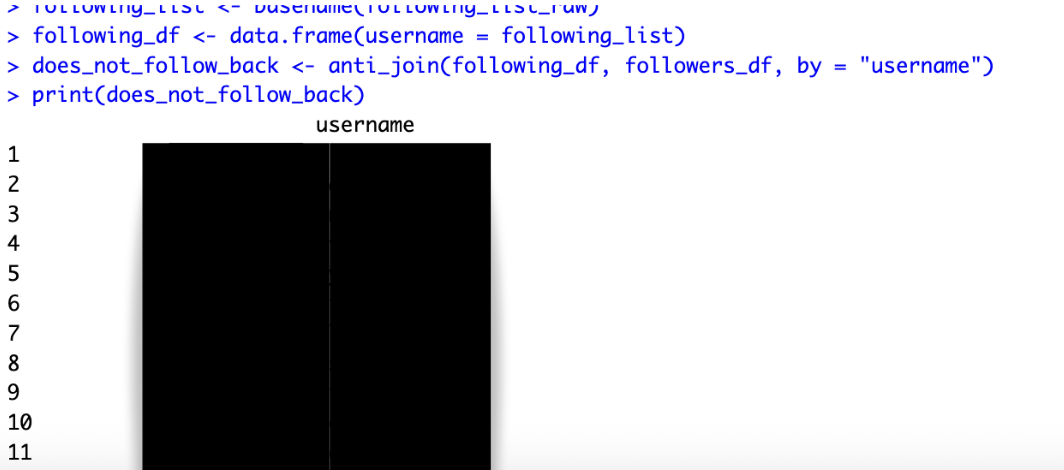
This culminated in the first mini-project I ever did outside of class – not for a resume, portfolio, or a grade. I used the tools from class for something totally unrelated. After downloading the HTML files of my Instagram followers and following, I built simple code to return who I follow that doesn’t follow me back. While this is, of course, a silly and egotistical use of my time, it is significant that I used the skills that I once pushed aside, and, even more importantly, that I enjoyed the process. 
When the Beat Drops: How Music Dictates Visual Storytelling

When I try to imagine where ideas come from, my mind initially goes blank. It kind of just “is,” that is, until we examine the full creative process. Let’s take the above video, (will be attached) which I made for my university Student of Color Fashion Show, to encourage models to sign up. The idea itself, seemingly, appeared from thin air, but, in truth, it was twenty years in the making. Realistically, around eight years, when I started stepping into the world of aesthetics, and the creative hip hop scene that inspired the video. Much like my fashion show designs itself, the way the video moves came from the music itself – when the beat drops, where suspense and tension builds, informs and creates the video itself.

Until the video is actually filmed, it doesn’t exist – it’s just an idea. It really  began when I hit “record,” right after explaining my vision to my friend who I had chosen to participate. The video, then, became a combination of her acting, our improvisation, and our adaptation to the circumstances of filming & trial and error of what looked the best. 

The penultimate step was editing and patching together the video. I tried different apps before settling on CapCut. It was a simple task – try out transitions between the “student” part and “model” part, and make sure the beat dropped during the transition. The vision became a reality – we had successfully conveyed the feeling of being a student and being a model, and had shown a convincing, pathos driven argument as to why students should sign up to model. 

Finally, the video was collab-posted from numerous accounts: the fashion show account, of course, as well as the model’s personal account and the club she ran. This was to maximize engagement, and also to spread the word more efficiently across campus. That year, we had a surplus of models sign up.

Why Obsessive Research Wins Interviews

When I prepare for an interview, I take the following steps. The first is preparation: I conduct deep, heavy research. When an artist reaches out to me and we lock in an interview, the prerequisite to research is a fluency in their entire discography, and a general knowledge of everything that comes up through Instagram and a quick Google search. Once this is done, I can begin digging. I am inspired by Nardwuar, someone often considered the “GOAT” of interviewing artists because of his personal touch in each interview. He often gives the artist a gift with deep sentimental meaning to them, or asks a question about something so niche, so personal to the artist’s life, that the artist will often be shocked to their core. Consequently, you can find many clips of different artists reacting to Nardwuar’s knowledge of them.

While I have not yet reached this level of intimate knowledge about an artist, I still like to know all about them. People, especially artists, have many lives, and to get as full a picture of an artist, I find it helpful to dive into the biggest parts of them. For example,  an artist may also have a clothing brand, or cook on the side, or be a professional consultant by day – it’s my job to synthesize it all, and paint the best picture of the artist as possible to the audience, so they may check out their music. The best part of the interview is the next part – the conducting – because, despite all the research, it’s a conversation, and it’s spontaneous, and anything could happen. It’s the unpredictability that makes interviews fun, and that makes art exciting. 

The “Olivia Rodrigo” Strategy: How to Captivate an Audience

Often, our most terrifying nightmares are the ones most likely to come to fruition. How often have you woken up in a sweat days before a presentation, fearing judgement – failure? To avoid this, here’s how I prepare to tell a story to a live audience: 

Every time, I always include a relatability factor – something that guides the audience through and, stylistically, reaches out and holds their hand. One example of this was when presenting on Race & Education Policy. I had firsthand experience with education policy, when making buttons to support a teacher strike. So, I brought these buttons in to pass around while I spoke about education policy. Students seemed to remember the presentation – afterwards, many came up to me, citing how the buttons helped them pay attention and differentiated the moment for them. 

While you can bring something physical, it is usually easier to have a powerful visual to guide the audience. As they say, a picture is worth a thousand words. During my time at Wesleyan, I took an A&R (artist and repertoire) class, where we pitched artists to sign to a label. The best pitch would be seriously considered as a potential signee to the professor’s own label.

Our group picked an artist similar to Olivia Rodrigo, in the bedroom pop aesthetic. To begin our presentation, we had an image of Olivia Rodrigo exactly mirror our artist – solidifying the idea that our artist would be the next Olivia Rodrigo. 

So, remember, when crafting a presentation, it may be helpful to consider how you communicate with your audience, and how to enhance the clarity of your story and your message. 

I Started a Music Media Platform for Selfish Reasons

I started Official Creator Space for selfish reasons. Since I was sixteen years old, I had always been frustrated with not being a part of the “blow up” of artists – I was watching from the sidelines, seeing all the key players (other artists, managers, brands, collaborators) move into position before a musician became popular. And, like a stockbroker who couldn’t invest, I’d look through the glass at the bullish market — alone in the dust. This frustration bubbled over and I started to build Official Creator Space. I realized that artists themselves are being exploited by the industry, so  I pivoted from an investment platform to  a fundraising platform. 

After this, I pivoted once more in method but not in mission. Now, Official Creator Space creates opportunity for upcoming artists through well-researched interviews. 

One semi-successful fundraiser later, I saw a poster for a DJ coming to campus. After researching heavily throughout the week, I had a plan to approach her and ask for an interview for the Instagram page. Inside the frat house in which she was performing, I sat in a room, buzzing  with pre-party excitement. I was experiencing a different type of buzzing – pre-interview anxiety. I asked a friend to come upstairs to the green room with me.. He followed me up the steps, and I knocked – carefully, but assertively – on the door the DJ was behind. The entire methodology  of the startup  was about to change. The door opened and I met my fate. 

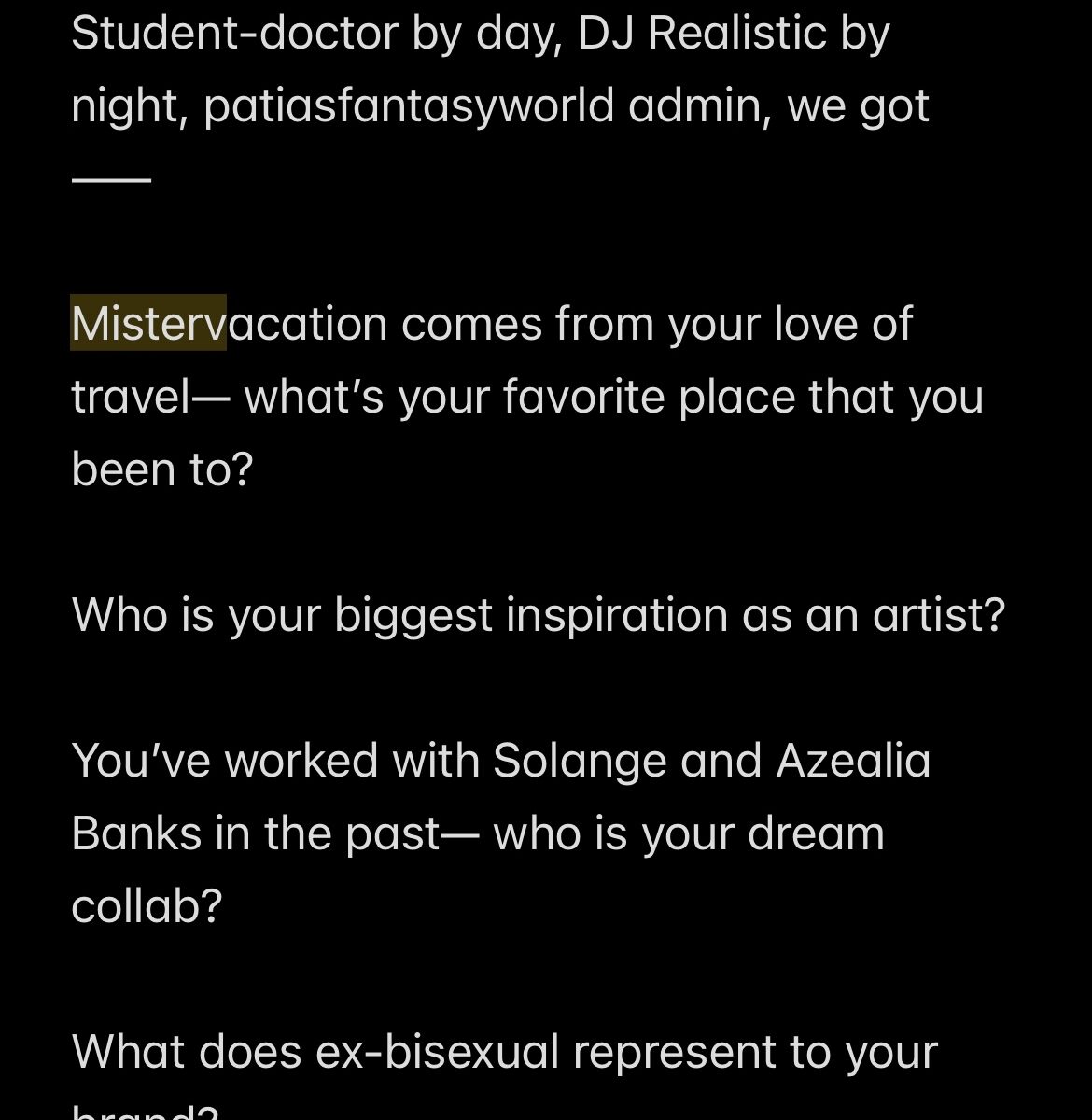
Since that day, I have completed interviews with twenty artists in the hip hop or rap-adjacent niches, ranging from upcoming talent to solidified legends in the game. I ask about their art, but also about the artist as a person, their goals, their upbringing, and anything unique about them. The purpose, though, is always the same – a way to create opportunity for upcoming artists, and to go against the grain of the music industry which uses artists as pawns for their profit incentive.

Orchestrating Tension: Inside the “Heroes & Villains” Runway

Wesleyan’s Students of Color Fashion Show gave me the opportunity to tell a story of “good” and “bad”  through my sophomore line, aptly titled Heroes & Villains. This was meant to push the audience to think through the nuance of morality. I began creating it by mapping loose “tension maps” on the wall of my dorm. The show was meant to flow like a song — and, most importantly, to leave the audience thirsting for more. I made drawings of how each look was meant to be, and how it connected to the story. Later, this manifested in personalized training with each model. 

Music was one of the most important parts of the story. It created swells, and tension. As the audience sits in anticipation, a man walks with ease and vigor up front, and the music – my own mix, created with help from on-campus artists – begins to build. A robotic voice instructs the audience to applaud. They do. The first three models begin their walks in tracksuits from a NYC based brand, as I stand on the sidelines. “Spider-Gwen” comes out next, as the lights turn pink. 

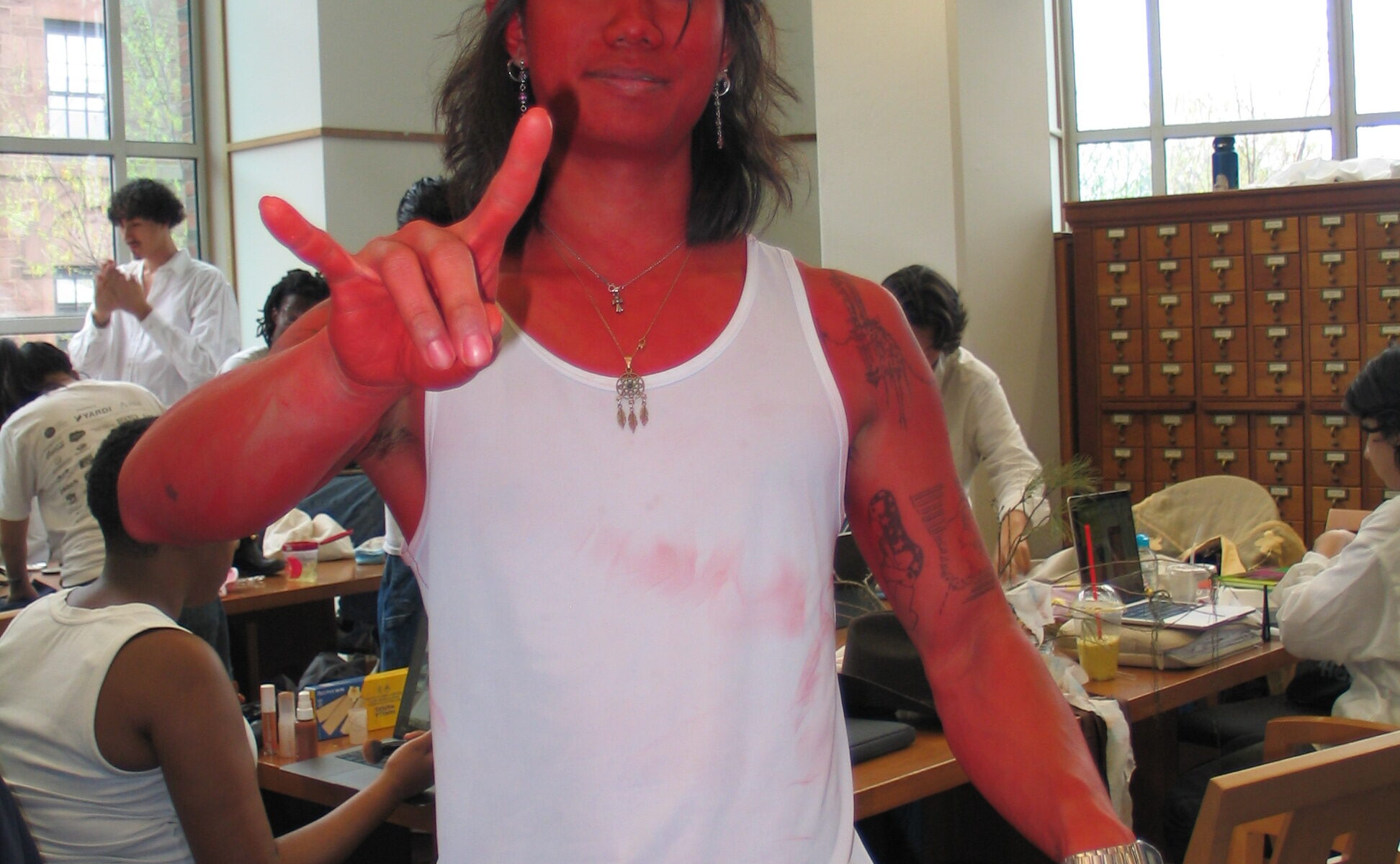
After her walk, the sands begin to shift as the music transitions to a gothic, house music beat. A man with long hair and a large black jacket makes his presence known, and, as the audience gazes upon him, he throws off his coat, revealing his red, demonic figure. His tattoos bleed through the red paint, as he leans back with an awe-striking pose. The royal guards of the desert appear, on either side of the T shaped stage, and bow to their Prince, who shrugs off the audience as mere subjects of his kingdom as his posse walks off the stage. I felt proud of my work and ecstatic seeing my vision realized.

As the models lined up to receive their applause, I stood at the back thinking of the promotional video I made on the SOC Fashion Show social media, and the messy papers in my dorm room, with incoherent lines that held stories. I smiled.

css.php